
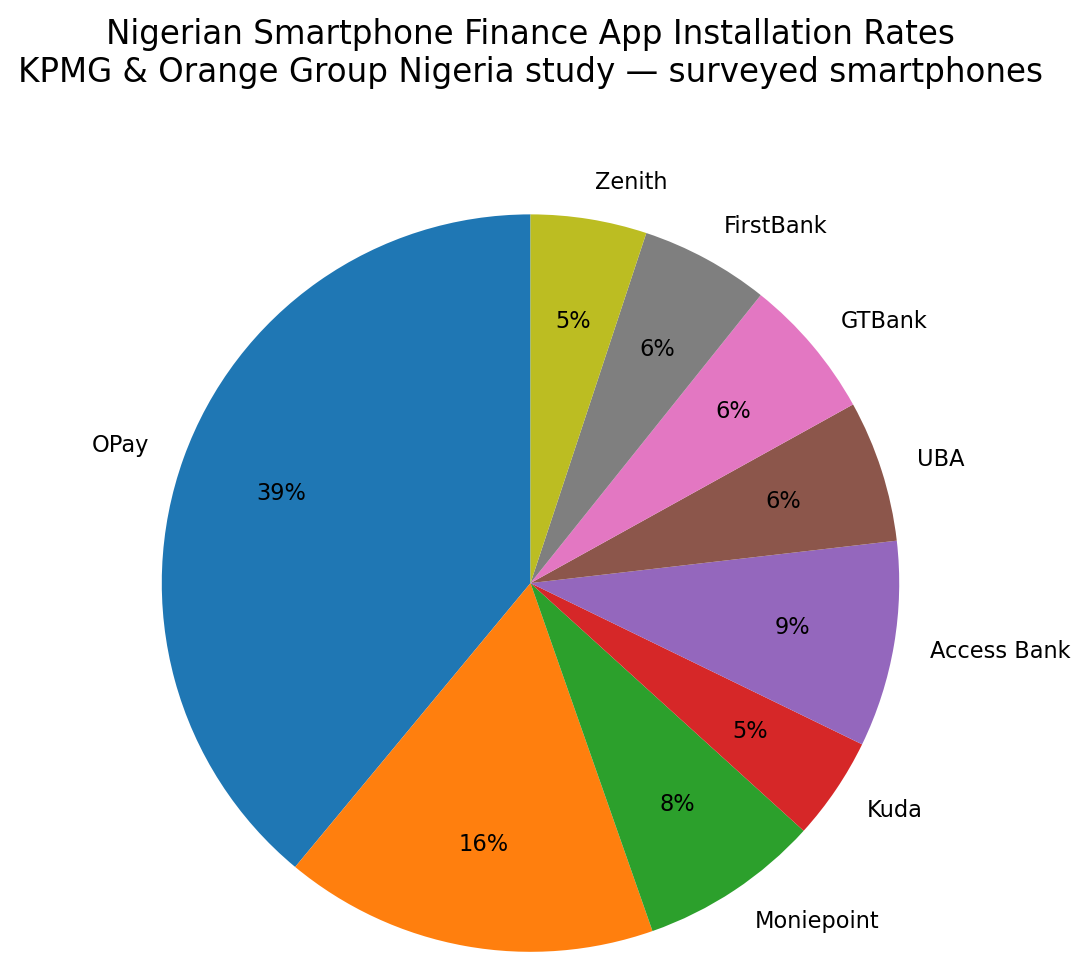
A new KPMG and Orange Group Nigeria study is highlighting just how deeply fintech platforms have penetrated the everyday financial lives of Nigerians. OPay was installed on 69% of smartphones surveyed across 12 major Nigerian cities, putting it well ahead of individual traditional banking applications. PalmPay followed at 29%, while Moniepoint and Kuda recorded 14% and 8% respectively. Among traditional banks, Access Bank led with 16%, followed by UBA and GTBank at 11% each, FirstBank at 10% and Zenith at 9%.
The numbers are striking, but they need to be read carefully. The 69% figure represents app installation across the surveyed smartphones; it is not a measure of OPay's overall market share, active customers, deposits or transaction value. That distinction is important because Nigerians increasingly use multiple financial platforms at the same time. One customer can have OPay for transfers, a traditional bank for salary payments, Moniepoint for business transactions and another platform for savings or investment products.
What the study does show is the strength of fintech distribution. Fintech companies have secured significant space on the devices Nigerians use to manage their everyday finances, and that gives them repeated opportunities to bring customers into additional financial products and services. The competitive question is therefore moving beyond who can get an app installed to who can turn that installation into regular financial behaviour.
OPay's position is particularly relevant because the company has expanded beyond basic payments into a broader range of financial services, including transfers, bill payments, airtime, savings and merchant services. PalmPay has followed a similar path. This broader product model gives customers more reasons to keep an application on their phones and more opportunities for the platform to become part of their daily financial activity.
That is where the idea of the fintech "super app" becomes commercially important. The value of an installed application is not simply the download itself. It is the potential to build a deeper relationship with the customer across multiple financial activities. A user who initially downloads an app to make transfers may eventually use the same platform for savings, payments, bills or business transactions.
The growth of smartphone ownership is providing an important tailwind for this expansion. The study cited in the source material puts smartphone penetration at 75% in 2025, up from 64% in 2023. As more Nigerians gain access to smartphones, the addressable market for digital financial services expands with it. The smartphone is increasingly becoming a distribution channel for financial products, reducing the importance of physical access points and allowing fintechs to compete directly for consumer attention.
Traditional banks, however, remain deeply embedded in the financial system. The presence of Access Bank, UBA, GTBank, FirstBank and Zenith on consumers' smartphones demonstrates that banking apps continue to play an important role. The more significant shift is in where the customer experience is taking place.
Banks retain advantages in areas such as established customer relationships, deposits, regulatory infrastructure and balance-sheet capacity. Fintechs, meanwhile, have increasingly competed around the digital experience — making transfers, payments and other financial services easier to access through mobile platforms. The result is a market where fintechs and banks are increasingly competing for the same screen space, even when they continue to play different roles within the broader financial system.
That makes the next phase of competition particularly interesting. Fintechs have demonstrated that they can win significant distribution through mobile-first products. The question now is whether they can convert that distribution into deeper and more valuable financial relationships.
Banks will also have to decide how they respond. Some may invest more heavily in their own digital ecosystems, while others may deepen partnerships with fintech companies or focus on providing the underlying infrastructure on which digital financial services operate. The Nigerian market is likely to contain elements of all three strategies.
For regulators, the growing presence of fintech apps also creates a different challenge. As these platforms become more deeply embedded in consumers' financial lives and handle larger amounts of customer funds and transaction activity, issues around consumer protection, cybersecurity, operational resilience and the management of customer funds become increasingly important.
For now, the KPMG and Orange Group data provides a useful snapshot of where the competition is taking place.
But the bigger story is not who has the most apps installed. It is who can turn that smartphone presence into sustained usage, meaningful balances, recurring transactions and long-term customer relationships.