
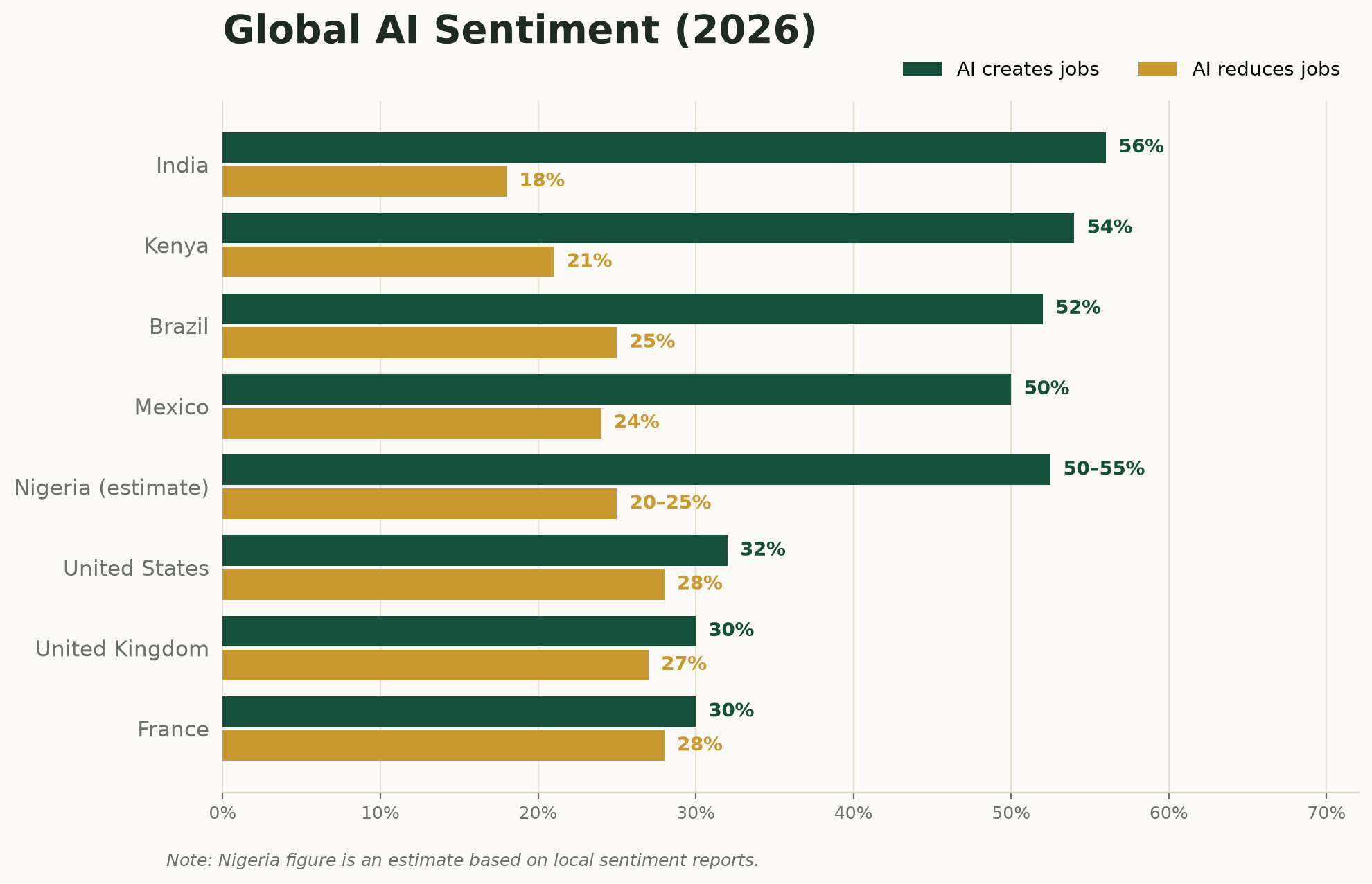
For the hundreds of thousands of Nigerian students who graduated this year from universities and polytechnics, the transition into the world of work mirrors global anxieties. While the UK's Bristol University graduates face shrinking vacancies as referenced by the Financial Times and rising debt, Nigerian graduates confront a different but equally complex landscape — one shaped by unemployment, underemployment, and the accelerating presence of artificial intelligence. A recent global AI review by a leading consulting firm surveyed over 22,000 people across 34 countries and found that opinions on AI's impact on jobs remain sharply divided. On average, 38% of respondents believe AI will create jobs, 27% think it will reduce employment, and 35% expect no significant change. In emerging economies such as India, Kenya, and Brazil, optimism is stronger: 56% of Indians, 54% of Kenyans, and 52% of Brazilians believe AI will create more opportunities. In contrast, richer economies such as the United States, United Kingdom, and France show more caution, with larger shares of the population expecting AI to reduce jobs. Nigeria sits somewhere in the middle. Although the country was not included in the 34-country survey, local labour market reports suggest Nigerian graduates are increasingly aware of AI's potential. A 2024 Jobberman Nigeria report indicated that more than half of young Nigerian professionals believe technology and AI will reshape the job market in the coming years. Based on this and comparable emerging-market sentiment, a reasonable estimate is that around 50–55% of Nigerian graduates expect AI to create jobs, while a significant minority worry it will replace roles. The Nigerian graduate experience is also shaped by factors that do not dominate headlines in Western economies. In Nigeria, the burden is not student loans but economic instability and limited job creation. Many graduates spend years in unpaid internships, low-paying roles, or informal work before finding stable employment. Yet, optimism persists. Nigeria's growing tech ecosystem, education reforms, and youth resilience suggest that the next generation of graduates could redefine success beyond traditional employment. For policymakers and employers, the message is clear: Nigerian graduates need more than degrees. They need digital skills, entrepreneurship support, and clearer pathways from education to employment. AI is not just a threat; it is also a tool that can help young Nigerians access global markets, remote work, and new business models. As Fintech Review NG continues to track how technology reshapes finance and work in Nigeria, this graduate outlook reminds us that the future of work is being written in real time — and Nigerian youth are both its subject and its authors.
Careers & AI10 September 20267 min readBy Omassan Gbenebichie
Nigerian Graduate Outlook in the Age of AI and Economic Uncertainty
Nigeria's graduates face a tight job market and rising AI anxiety. We set the local picture against a 34-market global survey on whether AI will create new jobs.