

Nigeria’s fintech story is entering a more demanding phase. The first wave proved that digital payments could reach millions of people quickly. The next will be judged by whether fintech companies can build trusted infrastructure that connects banks, businesses and consumers across products and borders.
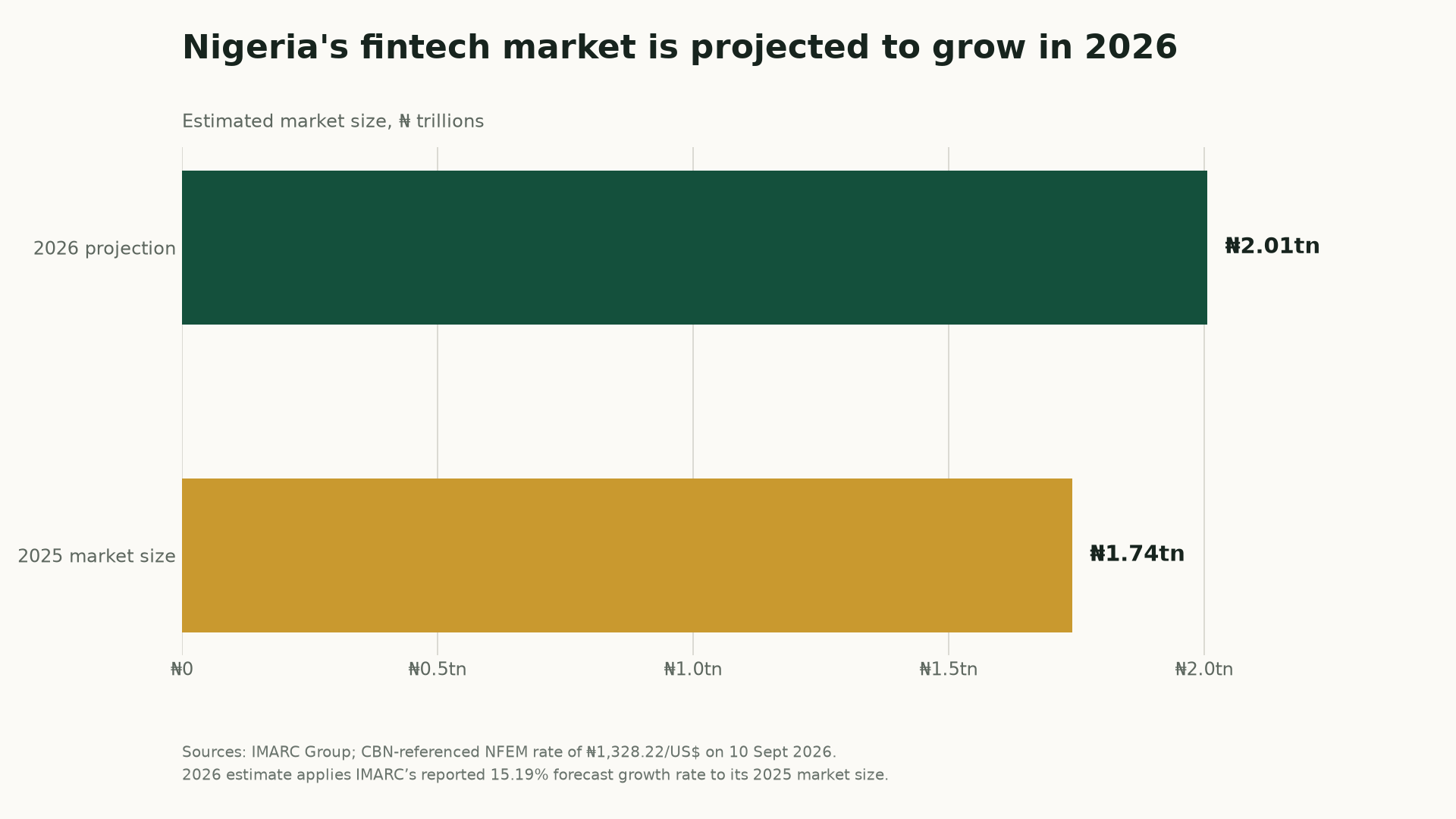
The market remains on a strong growth path. IMARC Group estimates that Nigeria’s fintech market reached an estimated ₦1.74 trillion in 2025. Applying its reported 15.19% forecast growth rate gives an estimated ₦2.01 trillion for 2026. These Naira estimates use the CBN-referenced NFEM rate of ₦1,328.22 per US dollar on 10 September 2026.
Exchange-rate context is based on the Central Bank of Nigeria’s published foreign-exchange rates.
Growth is moving beyond payments
Payments remain the sector’s foundation, but they are no longer the whole story. Digital wallets, mobile payments and online lending continue to widen access, particularly for people and small businesses underserved by traditional branches. At the same time, the industry is expanding into fraud prevention, data-sharing, embedded finance and international money movement.
This shift matters because the next competitive advantage may not be another consumer app. It may be the infrastructure underneath it: faster identity checks, safer data exchange, dependable settlement and tools that let businesses add financial services directly to the products their customers already use.
TechCity’s overview of the sector similarly identifies AI, open banking, contactless payments, compliance, cross-border rails and embedded finance as defining trends. Taken together, they show a market moving from single-purpose payment products towards a connected financial system.
Open banking creates a new layer of competition
Nigeria already has a formal regulatory base for open banking. The Central Bank of Nigeria’s operational guidelines set rules for how participating institutions can share customer-permissioned financial data through standard interfaces.
If implementation matches the ambition, customers could connect accounts across providers more easily, while businesses gain better tools for account-to-account payments, affordability checks, cash-flow analysis and personalised services. The opportunity is significant, but consent, data protection and clear accountability will determine whether consumers trust the system.
The next phase of Nigerian fintech will be won on trust, interoperability and practical usefulness—not downloads alone.
AI will increasingly work behind the scenes
Artificial intelligence is likely to be most valuable where it solves costly operational problems. Fraud detection systems can identify unusual behaviour more quickly, lenders can improve risk assessment, and support teams can prioritise cases that need human attention.
But automated decisions also introduce risk. A credit model can reproduce unfair patterns, a fraud system can lock legitimate customers out of their money, and an opaque chatbot can make dispute resolution harder. Companies using AI in financial services will need clear review processes, auditable decisions and a reliable route to a person when automation fails.
Cross-border services are becoming core infrastructure
For Nigerians earning, trading or supporting family across borders, international transfers are not a niche feature. They are part of everyday financial life. Fintech firms are responding with faster remittance services, multi-currency accounts and payment tools designed for freelancers, exporters and small businesses.
The strongest providers will be those that make complex international systems feel simple without hiding the true exchange rate, fees or delivery time. Regulatory cooperation across African markets will also matter: expansion becomes more durable when compliance can travel as effectively as technology.
Blockchain’s practical test
Blockchain adoption is also increasing, but its value should be measured by outcomes rather than attention. Distributed ledgers can improve traceability and settlement in specific use cases, yet consumers benefit only when the technology makes a transaction safer, cheaper or more reliable.
That practical standard is important in a market where trust is still fragile. Products should explain who holds customer funds, how redress works and what protections apply—regardless of the technology operating underneath.
What the next decade demands
Interoperability: products that work across banks, wallets and borders.
Responsible automation: AI systems with human review and clear accountability.
Transparent pricing: fees and exchange rates customers can understand before they transact.
Reliable consumer protection: fast reversals, accessible support and meaningful redress.
Infrastructure for inclusion: services designed for rural users, small businesses and people with limited connectivity.
Nigeria’s fintech opportunity remains substantial, but scale alone is no longer enough. The sector’s next chapter will be defined by the quality of the financial infrastructure it creates—and whether that infrastructure earns the confidence of the people who depend on it.