

Nigerian businesses entered September 2026 with a much stronger sense of optimism. The Central Bank of Nigeria’s latest Business Expectations Survey shows the Business Confidence Index rising to 14.8 points, up from 5.7 in August.
The improvement is more than a one month bounce. Respondents expect confidence to climb to 23.6 points in September, 30.1 over the next three months and 36.1 over the next six months. Increased demand, economic diversification and the monetary policy stance were the leading reasons for the brighter outlook.
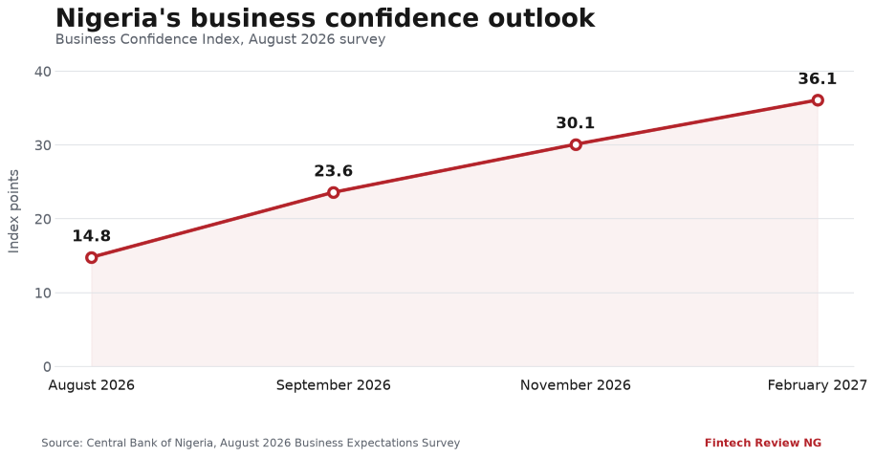
Confidence improved across the economy
All broad sectors reported a positive outlook in August. Industry’s confidence reading increased from 11.5 to 17.1 points, services rose from 3.6 to 13.3, and agriculture advanced from 3.4 to 13.9.
When businesses assessed their own operations, electricity, gas and water supply recorded the strongest confidence at 50.0 points. Mining and quarrying followed at 46.7, while agriculture reached 44.9.
Businesses were most optimistic about total orders and the volume of business activity, suggesting that expectations of stronger demand are supporting the broader improvement in sentiment.
A firmer Naira is expected, but credit remains tight
Survey respondents expect the Naira to appreciate across all review periods. The exchange-rate expectation index rises from 8.5 in the current month to 15.1 next month, 23.5 over three months and 31.8 over six months.
That optimism sits alongside persistent financing pressure. Borrowing rate indices remain around 18–19 points over the forward periods, indicating that businesses expect credit costs to stay elevated, even if they ease marginally over time.
The biggest obstacles facing businesses
· High or multiple taxation: 67.8 index points
· Insecurity: 66.9 index points
· High interest rates: 63.5 index points
Average capacity utilisation was broadly unchanged at 55.8%, compared with 55.9% in August. Mining and quarrying recorded the highest utilisation rate at 58.1%.
Why global interest rate decisions still matter
Nigeria’s domestic outlook cannot be separated from global monetary conditions. Higher or longer lasting policy rates in major economies tend to strengthen demand for developed-market assets, raise international borrowing costs and reduce the pool of capital available to emerging markets.
For Nigeria, tighter global financial conditions can increase pressure on the exchange rate and make foreign-currency funding more expensive. They can also require domestic assets to offer more competitive risk-adjusted returns to attract and retain investment.
The effect is not uniform. Decisions by the US Federal Reserve typically have the broadest influence through the dollar and global funding markets. UK rates matter for Nigerian companies with sterling exposure and may affect the finances of diaspora households. A tighter policy stance in Japan can also reduce global liquidity by making yen-funded investment strategies less attractive.
What this means for the CBN
The survey points to genuine improvement in business sentiment, but it does not remove the need for caution. The CBN must balance currency and inflation stability against the growing burden of expensive credit.
· Preserve macroeconomic stability: avoid loosening policy before inflation and foreign-exchange conditions are firmly anchored.
· Improve productive credit access: address financing constraints without undermining the broader monetary stance.
· Strengthen foreign-exchange resilience: deeper and more transparent markets can help absorb shifts in global capital flows.
· Support diversification: businesses already identify diversification as an important source of optimism.
Nigeria’s improving business confidence is encouraging. The next test is whether that optimism translates into stronger investment, output and hiring while firms continue to navigate high interest rates, taxation and security concerns.
Source: Central Bank of Nigeria, August 2026 Business Expectations Survey. The discussion of international monetary policy explains transmission channels and does not assert specific future rate decisions or probabilities.