
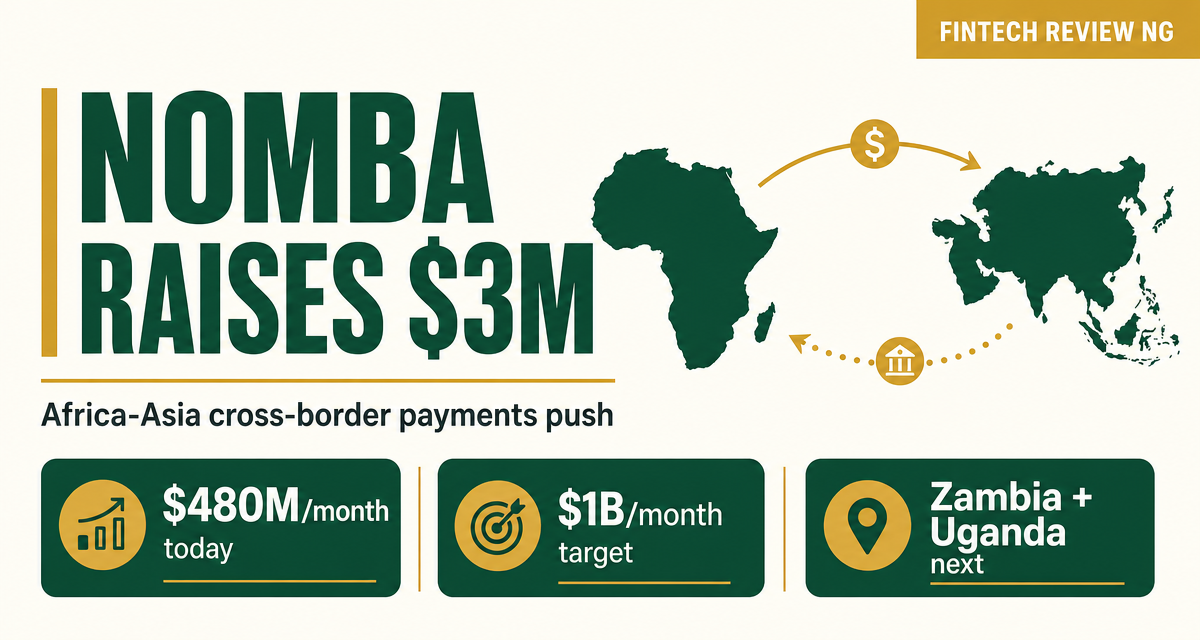
Nomba has raised US$3 million in debt financing from CardinalStone Finance to scale cross-border payments between Africa and Asia — a modest headline number attached to an unusually consequential ambition.
The Nigerian merchant-payments company currently processes roughly US$480 million a month and is targeting US$1 billion a month, with expansion into Zambia and Uganda already underway and a further US$20 million to US$50 million raise planned.
Our read: this is a working-capital deal, not a growth-equity round, and that distinction is the whole story. Understanding why tells you more about where Nigerian payments is heading than the dollar figure does.
The deal at a glance: Nomba raised US$3 million through a debt facility from CardinalStone Finance. The stated purpose is to support cross-border Africa–Asia payment corridors. The company currently processes about US$480 million per month and is targeting US$1 billion per month.
Cross-border settlement is a balance-sheet business before it is a technology business. To settle a Nigerian importer's payment to a supplier in Guangzhou quickly, a provider must pre-fund liquidity on both sides of the corridor. That float is working capital, and working capital is properly financed with debt rather than diluted equity.
So the US$3 million should not be read as a valuation signal. It should be read as evidence that a Nigerian lender is now willing to underwrite payment float against transaction data — a quiet but meaningful maturing of local credit markets for fintech.
The Africa–Asia corridor is the right target.
China is Nigeria's largest source of imports, and a very large share of that trade is settled today through informal channels: aggregators, Bureau de Change intermediaries, and WeChat-mediated settlement between trusted parties.
Those routes are fast but opaque, unhedged, and unauditable.
Formal alternatives are often slow. Correspondent banking can take days and carries layered FX spreads. Documentation demands from banks can exclude most small importers entirely. Pricing is also rarely disclosed as a single all-in number, making comparison difficult.
Any provider that delivers same-day settlement with a transparent all-in rate and a receipt an auditor accepts is not competing on convenience — it is competing against informality.
That represents a large, underserved market with genuine willingness to pay.
Nomba's move from US$480 million to US$1 billion in monthly volume represents roughly a 2.1x increase. That is aggressive but not fanciful for a merchant-acquiring business layering corridor volume onto an existing base.
Three conditions must hold.
First, liquidity depth. Corridor volume consumes float linearly. A US$3 million facility supports a pilot, not a billion-dollar run-rate. The planned US$20 million–US$50 million raise is the real enabler.
Second, licensing and compliance. Each new corridor and market adds a regulator. Zambia and Uganda are sensible, lower-friction proving grounds before larger markets.
Third, margin discipline. Volume growth in payments is easy to buy and hard to keep. The metric to watch is revenue per transaction, not volume alone.
There are also risks.
FX exposure is significant because pre-funded corridors carry Naira devaluation risk. Users should ask how positions are hedged and who bears the loss when settlement is delayed.
Concentration risk is another concern. Reliance on a single lender or a small set of corridor partners can create fragility rather than strength.
Regulatory sequencing is also critical. Expanding into new jurisdictions ahead of full licensing is a common and costly fintech error.
Finally, support capacity must grow alongside transaction volume. Cross-border disputes are harder and slower to resolve than domestic transfer failures. Growth without a matching dispute-resolution function can quickly produce customer complaints.
For Nigerian businesses importing from Asia, the practical questions are narrow and answerable.
Ask for the all-in cost as a single percentage of the amount sent, including the FX spread.
Ask for a committed settlement window in hours.
Ask what documentation you will receive for tax and audit purposes.
And ask what happens, in writing, when a payment is delayed.
A provider that answers all four in plain language is worth trialling with a small consignment. One that answers none is asking you to fund its learning curve.
Our verdict is straightforward: Nomba's strategy is directionally right, appropriately financed, and still early.
The Africa–Asia corridor thesis is one of the strongest strategic cases in Nigerian payments today, and using debt rather than equity to fund payment float is the correct instrument.
But US$3 million is a pilot cheque against a US$1 billion monthly ambition.
The deal that actually decides this story is the planned US$20 million–US$50 million raise that follows.
We will assess execution on disclosed all-in pricing, settlement times we can measure, and licensing in Zambia and Uganda — not on volume announcements alone.
What we will monitor is simple: published all-in corridor pricing, median settlement time on Nigeria–China transfers, licence confirmations in Zambia and Uganda, closing of the larger facility and its cost of capital, and dispute and reversal handling times as volume grows.