
For Generation Z (Gen Z), demographic cohort between ages 19-29, digital finance is becoming part of everyday life.
With a few taps, money can be transferred, invested, borrowed or spent. Cards can be stored on devices, subscriptions can renew automatically, and payments can happen almost instantly.
The question is no longer whether fintech has made financial transactions easier. The more important question is:
When technology removes friction from financial decisions, does it also make poor financial decisions easier?
Entertainment, software, cloud storage and other digital services can now be paid for through relatively small recurring transactions. Each payment may appear affordable on its own. But several “small” payments can quietly become a significant monthly expense.
This is the paradox of financial convenience.
The same technology that makes saving easier can make spending easier. The same interface that allows someone to automatically move money into savings can also allow another payment to happen without requiring a fresh decision.
The transaction becomes effortless. The financial consequence does not.
That distinction is becoming increasingly important as fintech becomes embedded in everyday life.
Gen Z is financially active — but financially vulnerable
It would be too simplistic to describe Gen Z as reckless with money. Nigeria's economic environment matters.
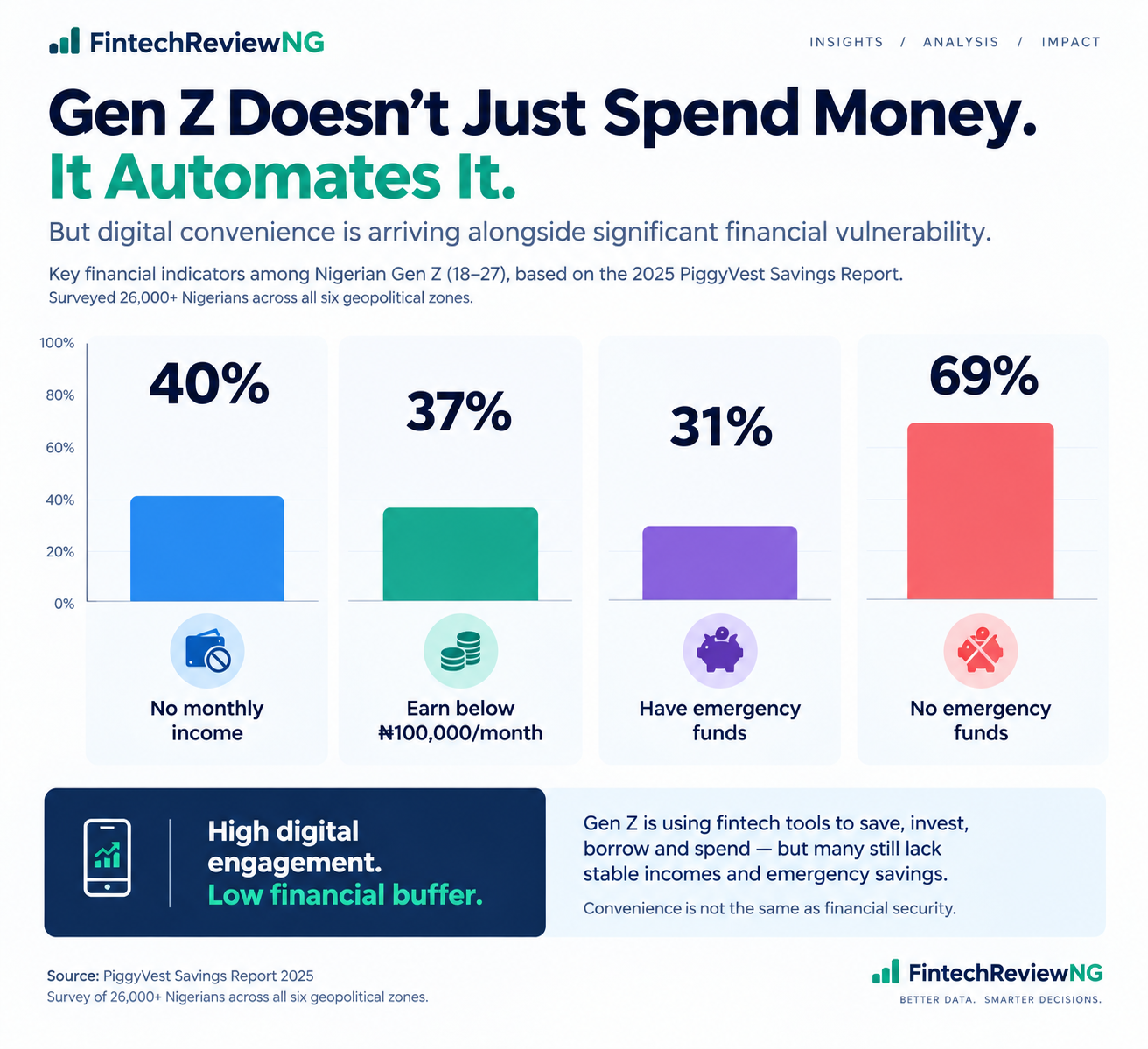
The PiggyVest Savings Report 2025, based on responses from more than 26,000 Nigerians across the country's six geopolitical zones, found that 40% of Gen Z respondents reported having no income, while another 37% earned below ₦100,000 per month. Only 31% reported having emergency funds.
That last figure is particularly significant.
Gen Z had the lowest emergency-fund coverage of all the generations measured in the report, compared with 45% for Millennials, 52% for Gen X and 47% for Boomers.
The numbers tell a bigger story
40% No income
37% Earn below ₦100,000/month
31% Have emergency funds
69% Do not have emergency funds
This is a generation experiencing high digital finance adoption alongside limited financial buffers. Fintech isn't the problem.
This is where the conversation needs more nuance. Digital financial services can help people save automatically, invest small amounts, access credit, make payments and manage money more efficiently.
The problem is what happens when financial convenience grows faster than financial resilience.
If a person has unstable income, rising living costs and little emergency savings, making payments frictionless does not eliminate the underlying financial pressure. It can simply make financial activity easier to execute. And that distinction matters for fintech companies.
What should fintech companies do?
The next phase of fintech competition should not be only about making transactions faster.
It should also be about making financial consequences more visible.
For example, fintech platforms could help users see:
how much they spend on recurring subscriptions; the cumulative cost of small transactions; the true cost of borrowing; how much of their income is committed before payday; how their spending changes month to month; and how long their emergency savings could actually last.
The opportunity is therefore bigger than another payment button or another credit product.
The next fintech advantage could be financial visibility.
Nigeria's fintech story has largely been about removing friction.
Payments became easier.
Transfers became faster.
Savings became more accessible.
Investing became more digital.
Credit became available through smartphones.
But the next question is more difficult:
Are these innovations improving financial outcomes, or simply making financial activity more convenient?
For Gen Z, that distinction could become increasingly important.
The generation most comfortable with digital financial tools is also operating in an economy characterised by inflation, unstable income and rising living costs.
That doesn't make Gen Z financially irresponsible. It makes the design of financial technology more consequential.
FintechReviewNG Verdict WATCH — FINANCIAL CONVENIENCE ≠ FINANCIAL SECURITY
Fintech has successfully reduced the friction involved in moving, saving, investing and spending money.
But removing friction is not the same as improving financial wellbeing. For Gen Z, the challenge is no longer simply getting access to financial technology. It is ensuring that technology helps them build financial resilience rather than simply making financial activity easier.
And for fintech companies, that may be the next major product challenge:
Don't just make money easier to move. Make its consequences easier to understand.
The PiggyVest Savings Report 2025 surveyed 26,000+ Nigerians across all six geopolitical zones on income, spending, savings, debt and financial satisfaction. The Gen Z figures above are therefore survey findings, not estimates of the entire Nigerian Gen Z population.