

The Dangote Refinery IPO has brought millions of naira of potential retail investment into one of Nigeria’s most closely watched capital-market events.
At ₦525 per share, the offer comprises 4.1 billion ordinary shares, with a minimum subscription of 10 shares, or ₦5,250. The offer opened on September 14 and is scheduled to close on October 13, 2026. The IPO for the People
The scale of the transaction has naturally generated discussion about what the shares could be worth after listing. But African capital-market history offers an important counterpoint to the excitement surrounding any major IPO:
A high-profile listing is not the same thing as a guaranteed short-term return.
Energy companies across African markets have experienced very different post-listing journeys. Some have generated substantial long-term value. Others have traded below their offer prices, experienced severe drawdowns or eventually been taken private.
For investors looking at Dangote Refinery, the more useful question is therefore not simply what the shares could be worth in the future. It is what the historical record tells us about the journey between an IPO and long-term shareholder value.
African energy listings show very different outcomes
The table below focuses on selected energy-related listings and the events that followed, rather than presenting raw “since IPO” returns as if they were directly comparable.
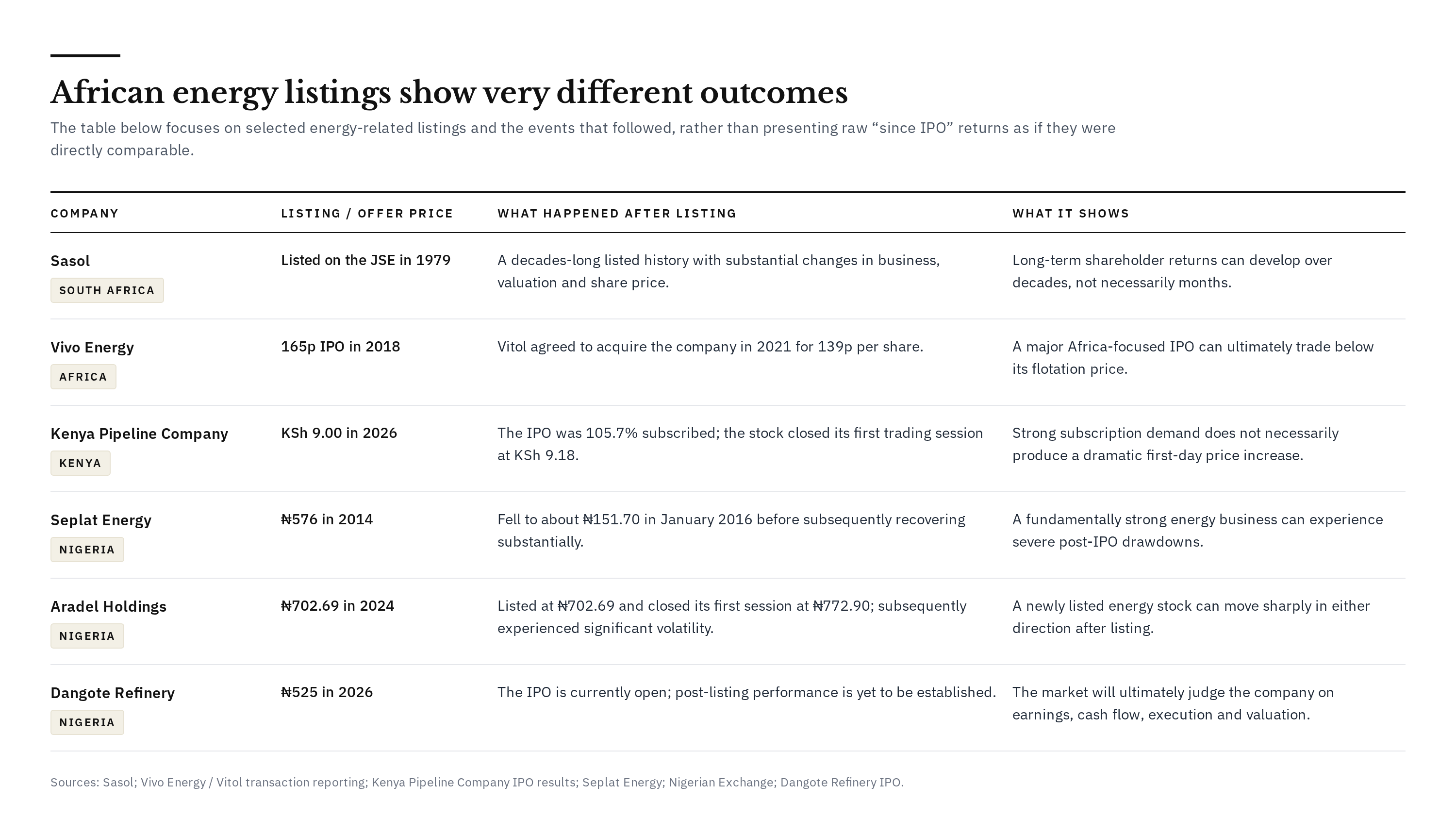
Sources: Sasol; Vivo Energy/Vitol transaction reporting; Kenya Pipeline Company IPO results; Seplat Energy; Nigerian Exchange; Dangote Refinery IPO.
1. Sasol: the long-term story can take decades
Sasol was listed on the Johannesburg Stock Exchange in October 1979, following its privatisation. Sasol describes the listing as the largest ever undertaken on the JSE at the time, while the public issue was reportedly oversubscribed 31 times.
The important lesson from Sasol is not a simple calculation comparing a 1979 share price with a 2026 share price. A comparison spanning almost five decades needs to account for corporate actions, dividends, changes in the company’s structure and the purchasing power of the underlying currency.
What the history does demonstrate is the length of time over which an energy company can evolve and create — or destroy — shareholder value.
The lesson: long-term equity returns are a process, not an IPO-day event.
2. Vivo Energy: a major African listing can disappoint
Vivo Energy, the Africa-focused fuel retailer, went public in London in 2018 at 165 pence per share. Three years later, Vitol agreed to acquire the remaining shares at 139 pence per share in a transaction valuing the company at approximately $2.3 billion. LiveMint
That does not mean the company was unsuccessful operationally, nor does it capture dividends or the full return experienced by every shareholder. But it does provide a useful capital-markets lesson:
A prominent energy business can enter public markets at a high-profile valuation and still fail to sustain that valuation.
For Dangote investors, this is a reminder that the size and strategic importance of a company do not determine its future share price on their own.
3. Kenya Pipeline: oversubscription does not guarantee a price surge
Kenya Pipeline Company’s 2026 IPO provides one of the most recent African examples. The company offered shares at KSh9.00 and received subscriptions for 12.49 billion shares against 11.81 billion offered, a 105.7% subscription rate. Yet the first-day closing price was only KSh9.18.
The IPO data also showed a significant institutional component: Kenyan institutions received approximately 7.45 billion shares, while Kenyan individuals received approximately 465 million.
Strong demand during an IPO does not automatically translate into a dramatic post-listing price increase. Demand, valuation, liquidity and the composition of investors all matter.
4. Seplat: the IPO can fall before it rises
Seplat provides perhaps the most relevant Nigerian case study. The company listed in April 2014 at ₦576 per share, raising approximately $535 million through its dual listing on the Nigerian and London stock exchanges. Seplat Energy
By January 2016, Seplat had traded as low as approximately ₦151.70, a decline of about 74% from its IPO price, during a period of severe weakness in global oil prices and pressure on the company’s financial performance.
The story, however, did not end there. By September 2026, Seplat was trading around ₦14,907.80 on the NGX. On a simple price basis, that is approximately 24.9 times the original ₦576 IPO price, or about +2,488%.
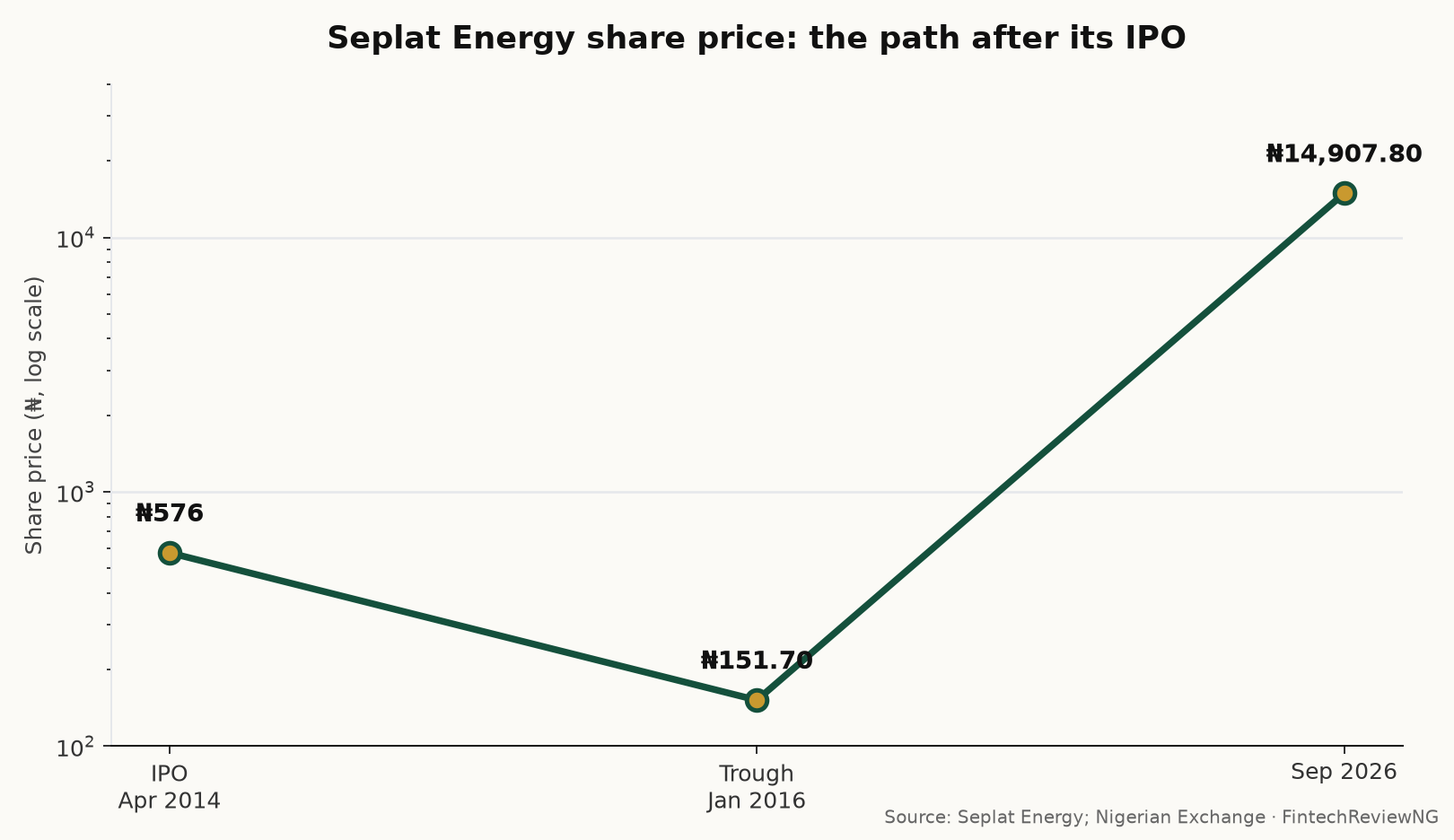
Seplat Energy share price: the path after its IPO. Source: Seplat Energy; Nigerian Exchange.
That figure is not a total investment return because it excludes dividends and other factors. Seplat itself says it has paid investors more than $400 million in dividends since raising $535 million at its 2014 IPO.
The more important lesson is the path: ₦576 → ₦151.70 → ₦14,907.80. The investor who judged the company only during its 2016 crisis would have seen a very different story from someone looking at the stock more than a decade later.
5. Aradel: listing does not remove volatility
Aradel Holdings was listed by introduction on the NGX in October 2024 at ₦702.69 per share and closed its first trading session at ₦772.90. Nigerian Exchange Group The stock subsequently experienced significant volatility.
This matters because investors can assume that a newly listed company should continue rising after a successful debut. There is no such rule. A share price reflects the market’s changing assessment of future earnings, risks, valuation and growth prospects.
A strong first trading session is not the same thing as a long-term investment return.
What does this mean for the Dangote Refinery IPO?
The historical evidence does not tell us where Dangote Refinery’s share price will trade after listing. It does, however, provide several useful frameworks for understanding the investment.
1. The IPO price is only the starting point
Dangote Refinery is being offered at ₦525 per share. After the IPO, the market will continuously reassess the company’s value based on financial performance, refining margins, production levels, crude supply, operating costs, debt, capital expenditure and growth expectations. The ₦525 offer price becomes a reference point — not a guarantee of future value.
2. The first year may tell investors very little
Seplat declined heavily after its IPO before recovering strongly. Sasol’s history stretches across decades. Vivo Energy’s public-market journey ended with a takeover three years after listing. Kenya Pipeline’s oversubscribed offer produced only a modest first-day gain. There is no single post-IPO trajectory.
3. Energy businesses carry distinctive operating risks
A refinery is not simply a company that sells shares. Its financial performance is tied to the economics of refining, including:
Crude oil supply and pricing
Refining margins
Refinery utilisation
Product demand
Foreign-exchange conditions
Operating costs
Infrastructure
Government policy
Financing costs
Maintenance and expansion expenditure
4. Currency matters
A Nigerian investor measuring returns in naira and an international investor measuring returns in dollars can experience very different outcomes from the same share-price movement. For a company operating in a dollar-linked commodity ecosystem, the interaction between operating performance, foreign exchange and shareholder returns deserves close attention.
5. Dividends are part of the investment equation
Share-price appreciation is only one component of equity returns. Seplat says that since raising $535 million through its 2014 IPO, it has paid investors more than $400 million in dividends. For Dangote Refinery, investors should distinguish between potential dividends and guaranteed returns: the official IPO information states that dividends are not guaranteed and depend on factors including company performance and decisions concerning distributions.
6. The real test begins after the IPO
Once the excitement around the offer fades, the market will focus on operating numbers. The key chain to watch is:
Production → Revenue → Refining margins → Profitability → Cash flow → Capital expenditure → Dividends → Valuation
That is where the long-term investment story will ultimately be written.
A bigger capital-markets story
The Dangote IPO is also important beyond whether its share price rises or falls. The offer brings a major industrial asset closer to Nigeria’s retail investment market through a large network of approved digital and traditional distribution channels. The official portal lists the offer at ₦525 per share, with a minimum subscription of 10 shares. The IPO for the People
This is another step in the convergence of fintech, capital markets and retail investing. Fintech platforms can make access to investments easier. But easier access does not remove investment risk. A subscription may take minutes. Understanding the business can take years.
The history of African energy listings does not provide a forecast for Dangote Refinery. It provides something more useful: context. Sasol shows how long-term equity stories can span decades. Vivo Energy demonstrates that a major Africa-focused listing can ultimately be acquired below its IPO price. Kenya Pipeline shows that oversubscription does not automatically produce a first-day jump. Seplat demonstrates that a stock can fall dramatically and still generate substantial long-term appreciation. Aradel shows that newly listed energy stocks can be volatile even after a strong debut.
The common thread is that the IPO is not the investment story. It is the beginning of it.
For Dangote Refinery, the market will eventually move beyond the excitement surrounding the offer and focus on the numbers:
How much does the refinery produce?
How profitable is it?
How efficiently does it operate?
How much cash does it generate?
How much capital does it require?
What valuation is the market willing to place on those earnings?
Those questions will matter considerably more than the excitement of the IPO itself.
Watch the business, not just the IPO
This article is for information and financial education. It is not a recommendation to buy or sell securities. Investors should read the approved Dangote Refinery IPO prospectus and consider the associated risks before making investment decisions.